Grading vs. detention pond: reading early earthworks in satellite imagery
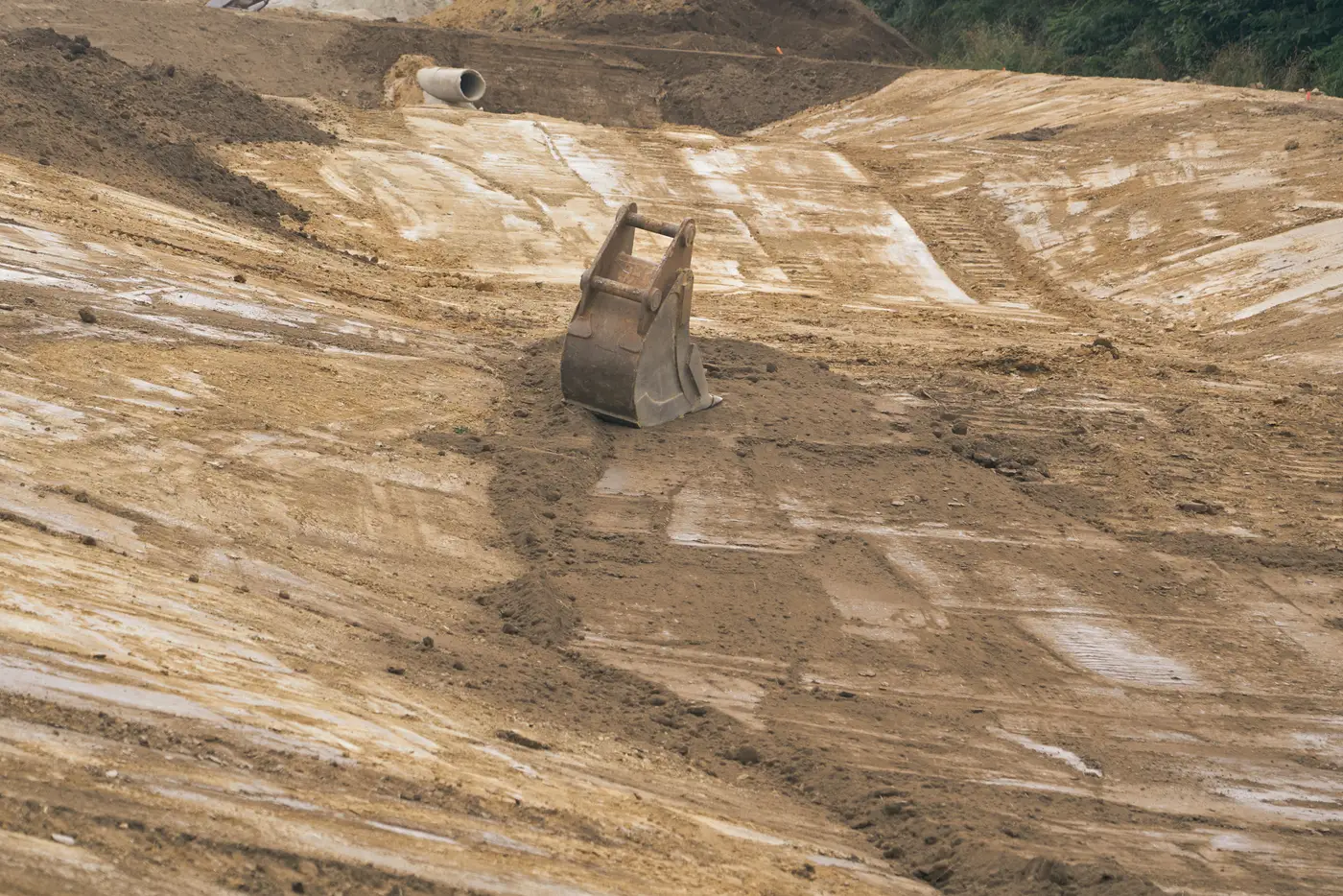
If you quote equipment ahead of a plant opening, you've probably pulled up a parcel in satellite imagery and seen two different kinds of disturbed ground and had to guess which one you're looking at. A graded pad and a detention pond excavation can look similar from altitude, both are bare dirt where there used to be grass or trees, but they tell you different things about where a project sits in its timeline.
What grading looks like
Mass grading produces geometric shapes. The cleared footprint usually matches the building pad or yard layout almost exactly: rectangles, trapezoids, sometimes an L if there's a dock addition planned. You'll see cut-and-fill striping where the dozer has leveled a slope, lighter tan bands next to darker disturbed soil, and the edges are straight because they follow a survey line, not a natural contour. Access roads show up as narrow, arrow-straight cuts running from the nearest public road to the pad. If you catch two passes a month or so apart, the cleared area on a graded pad tends to grow outward toward the final footprint as mobilization ramps up.
What a detention pond looks like
A stormwater basin reads differently. It's dug below grade rather than leveled flat, so it has a berm ring piled around the rim, and the shape is curved or kidney-shaped more often than square, because civil engineers shape basins to hydraulics, not to a building footprint. Look for a smaller forebay cell tucked next to the main basin, that's the sediment trap, and a small round structure near one edge, the outlet riser. After a rain event, the basin floor often shows standing water as a dark patch, sometimes near-black, which is one of the more reliable tells since a graded pad almost never holds water on purpose. Ponds also sit at the low point of the parcel, frequently tucked against a property line or drainage easement rather than centered on the site.
Why the order you see them in matters
On a lot of civil plans, the sediment and erosion control basin goes in before mass grading starts, not after. That temporary basin gets enlarged or reshaped into the permanent detention pond once the site stabilizes. So it's entirely normal to catch a pond-shaped cut in the imagery weeks before the main pad shows any disturbance at all. If you're used to treating "pond built" as a late-stage signal, you'll read that pass as further along than it is, or worse, miss it as the actual first break of ground.
The reverse order shows up too, especially on sites where the pad is cleared first and the stormwater work gets permitted separately or phased to a later contractor mobilization. Neither order is wrong. A pond excavation by itself tells you a civil contractor has mobilized on that parcel. It doesn't tell you whether grading is done or hasn't started, and you need the next pass to see whether the pad footprint is moving too.
Another thing worth watching: basin size is usually fixed once dug to design depth, so it doesn't keep expanding across passes the way a graded pad does. If the cleared area around a pond stays the same size month over month while the surrounding pad keeps spreading, that's consistent with normal sequencing. If the pond area itself keeps growing, you're probably looking at something bigger, a borrow pit or a multi-cell wet pond for a larger facility than you assumed.
Check the cleared footprint on this parcel against last month's pass, and note which direction it's moved, outward on the pad, steady on the pond. A standing watch on a parcel catches that shift instead of a single snapshot, which is the core idea behind Greenfield Watch, a monthly pass over a defined area built to catch that first break of ground before anyone's filed for a permit lookup.
If you've got a parcel you're already watching for the next earthworks pass, that's exactly the kind of area Greenfield Watch is built to sit on.